Net Zero Solar is a Full-Service Solar Installation Company
520.207.4053

Understanding TEP’s Energy Storage Rewards Program with Enphase Batteries

Did you know that Tucson Electric Power has a pilot program that allows you to get paid if you allow them to use your batteries to support the grid? This “virtual power plant” program allows our clients with Enphase batteries to potentially save more on their electricity bills, if they allow TEP to discharge their batteries to the grid up to 100 times each year.

Read on to learn more about the basics of VPPs, the details of how TEP’s program works, some estimates regarding compensation, what we see as the pros and cons of enrolling in the program, and how to enroll.

For those who’d like the bottom line up front, we think this program can be really financially beneficial for those who have or are considering installing batteries, but it’s important to understand the details of the program before participating.

Disclaimer

In this post, we are sharing our best understanding of how this program works, based on materials from Tucson Electric Power, Enphase Energy, and our individual experience in the program. We are not representing TEP or Enphase. We recommend that you review all program information directly on TEP and Enphase’s websites, especially the terms and conditions.

What is a Virtual Power Plant?

A virtual power plant, or VPP, is a way to bring together many distributed resources to support the grid and grid reliability. These distributed resources can be smart thermostats, smart water heaters, electric vehicles & their chargers, home solar and battery systems, and more.

In short, VPP devices are anything that can be controlled by the utility to reduce load on the grid, or ideally, send energy to the grid. Many of you may be familiar with utility programs that allow them to control your thermostat, slightly adjusting your temperature up during peak times, and lowering the peak load on the grid. 

When you aggregate home batteries as a VPP, the resource is even more valuable–all these batteries acting in concert become like a small power plant! Recently, TEP shared that the first 150 participants in their VPP program were able to reduce demand by 1,300 kilowatts–and there are even more participants now.

Utilities like VPPs because they provide capacity at a relatively low cost, without the need for them to build or own infrastructure. Utility regulators at the Arizona Corporation Commission like these programs because they save utilities money, and provide benefits to ratepayers.

Self-Consumption with an Enphase Battery

Before we share the details of TEP’s program, let’s talk about how Enphase home battery systems are usually operated by our clients. The screenshot below shows a typical day with solar and a home battery system. Scroll down for a detailed explanation of what’s happening.

This screenshot from the Enphase monitoring shows a lot of information! Let’s talk about each part. First, the green graph at the bottom shows how full the battery is–what we call “state of charge,” or SOC. The blue bars above the x-axis show the solar production. The green bars above the axis show battery discharge, and the green bars below the axis show battery charge. The gray bars below the axis show energy exported to TEP’s grid. And last, the orange bars show energy consumption in the home. Oh, and that red line? That’s energy used to charge an electric vehicle.

That’s a lot of information, but let’s cut to the chase: From midnight, the home uses the energy stored in the batteries to power the electrical load in the home. Once the sun comes up, the solar electric system starts producing power, and the batteries start to charge. Once the batteries are fully charged, excess energy is sent to the grid. In the evening, the energy from the batteries is once again used to power the loads in the home.

TEP Energy Storage Rewards Program Basics

You can find all the details of this program on TEP’s website,  and a great frequently asked questions page on Enphase’s website,  but we want to break it down a bit.

Compensation

TEP will pay $120 per kW average delivered across events during a season (winter or summer), paid as a bill credit 2-3 bills after the end of the season. TEP customers can request a payment check at any time if they have a credit on their account, or simply keep the bill credit on their account for future use. You might be wondering: What does $120 per kW average really mean? We’ll share more.

Seasons

TEP breaks the program into two seasons. The summer season is May-September, and the winter season is October-April. These are the same five-month and seven-month seasons that TEP uses for their time-of-use rates.

Events

TEP calls each time that they use batteries for grid support an “event”. Under the terms of the program, they can call up to 100 events per year, for any day–holidays and weekends included. 

Each event can be 1-4 hours in duration. Most events we’ve seen so far have been three hours long. Generally, the batteries will be discharged during peak hours of 3-7pm in summer and 6-9am & 6-9pm in winter. 

If you participate in the program, you are automatically included in each event, but you can also choose to opt-out of any individual event. TEP will also try to avoid scheduling events when storms are forecast, to save your battery capacity for backup in the event of a grid outage.

How will you know if an event is scheduled? TEP will send you an email or you can also see upcoming events in Enphase’s Enlighten monitoring app.

One thing to note is that TEP/Enphase may send a signal to charge your batteries before an event, to make sure they are ready for the event. If it’s not sunny, you will have to buy this energy from TEP.

Imported and Exported Energy

The program provides an additional payment based on your batteries’ contributions, but changes nothing in terms of your current billing arrangement with TEP.

If you import any energy during the event or before the event to charge the batteries, you’ll buy that energy from TEP as usual. Similarly, you’ll be paid your export rate (or retail rate for net metered systems) for any energy you send out to the grid during an event.

An Example Energy Storage Rewards Event

So what happens during an energy storage event? Let’s take a look at one of the first events on my system, from earlier this year, on February 8th. TEP sent me an email a few days before the event, letting me know that this and two other events were scheduled. This event was planned to last from 6:00pm-9:00pm.

Twelve hours before the event, Enphase sent a signal to charge my batteries to 100% in preparation. Although it’s understandable that they want the batteries to be fully charged in preparation, this is a bit annoying, as the batteries were charged from the grid rather than the plentiful solar energy available throughout that day.

At 6:00pm, the battery started discharging on command from TEP & Enphase, at the maximum output power of 11.52 kW. Because I’ve dedicated 13.5 kWh of my battery to this program, it took about an hour and 15 minutes to discharge my batteries down to 10%. After that, the batteries were idle until 9:00pm, when the event ended. At that time, my system automatically charged up to my normal self-consumption reserve value of 25%.

This figure shows the summary of the event from the Enphase Enlighten app. The energy I exported represents an average of 4.07 kW over the three-hour event on February 8th. You can also see two other events in the screenshot, from February 1st and 9th.

Calculating Compensation

The biggest question we’ve heard about participation in this program is: “How much would I get paid?” For better or worse, the answer is complex. We’ll work through the math together. The bottom line is that if you’re willing to give up some control of your system and enroll in this program, the financial benefits can be significant.

TEP compensates those in this program based on their average output in kW during battery events. This is because utilities mostly think in capacity, not energy. They have to balance the whole grid–the total load on the grid has to equal the total energy production at any moment. 

Let’s look at an example, using this table from TEP’s website, for a 10 kWh battery that can deliver 90% of its capacity. Let’s focus on “Event 2.” Event 2 is two hours long, and 9 kWh was delivered in those two hours. So the average capacity is 9 kWh / 2 hours = 4.5 kW.

If you do the math on this table, the average capacity delivered is 3.0 kW. If this table represented an entire season, the compensation from the season would be 3.0 kW * $120/kW, or $360. Not bad! 

Compensation Per kWh

For most of us with batteries, we think of our systems in terms of their usable capacity in kWh. So can we figure out a typical compensation per season per kWh? Let’s try! Here are the steps we can take:

● We estimate that TEP will have 50 events per season, split between winter and summer.
● Assume we have a 10 kWh battery system (the smallest we install), that we’re willing to discharge 90%, or 9 kWh, down to a state-of-charge of 10%.
● If we discharge that 9 kWh during 50 events, we’ll have discharged 9 kWh * 50 events = 450 kWh total
● Using the average event length of 2.625 hours per TEP’s example, we will have a total number of event hours equal to: 50 * 2.625 hours = 131.25 hours of events that discharge the batteries
● So, our average capacity delivered will be: 450 kWh / 131.25 hours = 3.43 kW
● Our season’s payment would be: 3.43 kW * $120/kW = $411.60
● Our payment per kWh discharged would be $411.60 / 450 kWh = 91.47¢/kWh

Of course, this is just an estimate. The number of events, distribution of events between summer and winter, length of events, opting out of events, and other factors could change the results. But the bottom line is 91.47¢/kWh is nothing to sneeze at!

Note that there are a couple factors that need to be subtracted from this value to reflect actual compensation. First, if you have to buy power from TEP to charge the battery, that’ll cost you. And if discharging your battery for an event means you then have to buy power from TEP during peak, that also will cut into that 91.47¢/kWh. You can see the values for energy bought from or sold to TEP for a system installed recently in the image below.

Program Pros and Cons

So what are some of the benefits and drawbacks of this program, in our opinion? Here’s what we came up with, but we’d like to hear your thoughts as well.

For benefits, the biggest is clearly the compensation. Battery owners get additional value from their investment. In a bigger sense, you are able to help support the grid with clean energy. I think the word that comes to mind is “interdependence.”

Some of the drawbacks that we’ve identified are the possibility of more cycles on the battery, though for Enphase batteries, we don’t see this as a big issue. Enphase batteries have a 15 year or 6,000 cycle warranty, whichever comes first. 6,000 cycles is 16.4 years with daily 100% charge and discharge, so most owners won’t reach the maximum cycle count before the end of the warranty period.

Other drawbacks are that the battery has to be charged before events, which will cost you if you’re charging from the grid. It’s also worth considering that if a power outage occurs after an event, while the batteries are discharged, you’ll have less or no backup power available, although you can choose settings to minimize this problem.  Overall, choosing to participate in the program gives you a little less independence. 

Program Enrollment

To enroll in this program, you have to wait until after your batteries have been installed and approved for operation by TEP. The actual signup process is quite easy, and can be done through your Enphase Enlighten app. The signup process explains the program, then has you read and sign some terms and conditions. After submission, it took about ten business days for me to be accepted into the program.

You’ll find a detailed walkthrough of the process here, or linked from the TEP Energy Storage Rewards page.

Specific Enphase Enlighten Settings

After enrollment, all settings for the program are completed through your Enphase Enlighten app. 

The most important setting is the battery discharge limit, under Menu → Services → Grid Services → Program Details → Battery Discharge Limit. This setting controls how much of your battery you dedicate to the Energy Storage Rewards program. You can choose to set it at a 10% discharge limit, allowing TEP to use as much as 90% of your battery capacity, or at a 70% discharge limit, allowing TEP to use up to 30% of your battery capacity, or anywhere in between.

Anywhere on this spectrum is a reasonable choice. Lower discharge limits mean more compensation, but less battery capacity dedicated to backup for your home after an event. If you want to prioritize your independence, but still participate in the program, you might consider starting with a battery discharge limit of 50-70%.

Note that the battery discharge limit setting is not the same as the self-consumption reserve percentage, which can be adjusted in Settings → Profile → Edit. The self consumption reserve percentage is the lowest that the batteries will be discharged during normal operation, not during an Energy Storage Rewards event. If this value is set higher than the battery discharge limit, and charging from the grid is allowed (see below), then the batteries will charge up to the reserve percentage after a TEP event is completed, as in the example we shared above.

You can choose whether you allow the battery to charge from the grid or not. You’ll find this in Settings → Battery. This can allow your battery to charge up to reserve level after events or outages which can be beneficial, but you’ll have to pay TEP for any energy you purchase from them.

Another key setting is the electricity rate, found in Settings → Electricity rate. This is important as it can change the charging and discharging behavior of a system with batteries. You’ll want to make sure the chosen rate matches your electric bill. For most of our clients, this will be the TRREST residential time-of-use rate. For customers still on net metering, it will likely be the TRRES residential basic rate.

We know this is a lot of settings to consider. If you’re a client of ours, we’d encourage you to get in touch with us, and we can discuss the details over the phone or a video call.

Wrap Up

Thanks for taking the time to read this article! We’d love to hear your feedback and questions! Please share them in the comments below.

Should I Install Solar or Batteries Now, with Tax Credits in Jeopardy?

You’ve probably heard on the news that Congress is considering tax cuts for the wealthy and cutting Medicaid in the big reconciliation bill. But did you know that they have also proposed cutting or eliminating tax credits for solar and batteries, for both individuals and businesses? 

We’ll share what’s happened so far, what we know about what might happen, and what you can do to help save these credits. We’ll also discuss if it’s a good idea to install solar and batteries before the end of 2025 to make sure you can use these credits no matter what happens in Congress.

What is Congress Planning to Do?

Congress is currently considering a budget bill that can pass through “reconciliation.” This means that the bill only needs a simple majority vote by Republicans in both the US House of Representatives and the US Senate, before being signed by the President. 

As of today, there is a 30% federal tax credit for both individuals and for businesses who install and commission solar and/or battery systems until the end of 2032, then gradually phase out starting in 2033.

On Thursday, May 22nd, the US House voted 215 to 214 to pass a proposed reconciliation bill which would be disastrous for clean energy in the US. Some of the key provisions include ending the 25D residential renewable energy tax credit to zero at the end of 2025 and ending the 48E business credit in 2028, but adding restrictions to the credit that make it basically impossible to use starting 60 days after the bill passes.

These changes would deeply impact the ability of consumers and businesses to install solar and batteries, and in turn, have an enormous detrimental effect on our business. We estimate that for the typical consumer installing solar, the simple payback on installation would increase by 5-7 years. SEIA, our national solar and storage trade group, has shared information on the impact of the house bill.

So what’s next? The Senate will consider the House bill, make changes, and send it back to the House. Although some Republican Senators have expressed support for making changes to the bill, no draft text has been proposed at this time.

What Can I Do to Help Save These Credits?

At this point, it’s all hands on deck for everyone to make their voices heard to their representatives. Overall, the solar industry is putting a lot of focus on Republican senators, so those of us who live  in Arizona won’t be able to make an impact there, as our two senators are Democrats.

But we can still continue to let our representatives know how important these credits are, especially Representative Juan Ciscomani in Arizona’s 6th congressional district. SEIA has created the Save Main Street Solar campaign which makes it easy to take action.

We also encourage you to consider writing a letter to the editor or an op-ed sharing how the credits have helped you go solar. And you can ask friends and family in other states to take a minute to share their thoughts with their representatives and senators.

Should I Install or Upgrade My Solar and/or My Battery System?

If you have been considering installing solar or batteries, or adding to your existing system, we strongly recommend you take action soon. It’s certainly possible that the Senate may modify the worst of the House bill, but we just don’t know if that will happen. We also expect that our limited installation schedule will fill quickly for the rest of 2025. It takes us 6-10 weeks from contract signing to install a system, depending on the complexity of the system, your specific building department, and other factors, so time will be quite limited if the Senate doesn’t improve the bill.

We also often hear questions about system upgrades–folks want to know if it makes sense to add more solar modules and microinverters, or to add batteries. Unfortunately, the answer is “it depends.” Overall, if you have significant bills or plan to add new loads such as an electric vehicle soon, you may want to consider adding to your system. 

Let’s start with batteries: If you want to have backup power when the grid is down, or have the independence of being able to store your energy onsite, batteries can make sense. Installing batteries won’t affect the amount your utility pays you for energy you send to them. You can learn more about the benefits on our batteries page.

For Tucson Electric Power customers with net metering, TEP has made it clear that you can add to your system as long as you do not require electrical infrastructure upgrades such as a new electrical panel or bigger transformer. Here’s the specific policy from TEP. If you are interested in adding to your net metered system, you can get in touch with us or email your original sales representative, and we can do a quick review to see if an upgrade is possible.

For TEP customers with export rate net billing, if you add to a system, your export rate will drop to the current export rate of 5.7¢/kWh for the remainder of your ten-year lock in period. If you’ve installed solar in the last year or two, this might not be a big impact. But for those who installed farther in the past, this drop in export rate could significantly reduce your savings. You can check with us for more information regarding your specific situation.

For SSVEC & Trico customers, an addition of solar will knock you out of net metering, and put you on an export rate that changes each year. Therefore, we generally don’t recommend adding solar. But batteries can be added without changing your current billing arrangement with Trico or SSVEC.

The Bottom Line

We encourage anyone thinking about solar and/or batteries to take action now. Spend a couple minutes telling your representatives how you feel. Next, get in touch with us if you’re considering installing or adding solar or batteries. Last, please let your friends, family, and colleagues know there may be only a limited time these credits will be available.

Because this is a developing story, and things may change quickly, we recommend that you also check out our Facebook or Instagram for updates. If you have questions or comments, please share them with us!

What Tucson Electric Power’s Proposed 2023 Rate Increases Mean for Solar Customers

The basics of TEP’s rate proposal

Back in June of 2022, Tucson Electric Power (TEP) filed an application with the Arizona Corporation to increase their rates for electric service. According to TEP, this rate increase is to account for increased costs, allow them to transition to cleaner energy sources, and allow them to better support the communities they serve. Other stakeholders such as ratepayer advocates have different perspectives, of course.

For residential customers, the proposed rate increase would be quite significant. It would raise bills on average around 12%, or about $14/month. Small residential users would see a slightly smaller increase, averaging around 11% or $12/month, while some large homes would see a 16% increase or more, with an average monthly increase of $35-45.

For commercial customers, small and medium sized businesses would experience similar percentage increases in their average monthly bills, while larger businesses would experience closer to a 6% monthly increase.

What Specific Changes is TEP Proposing?

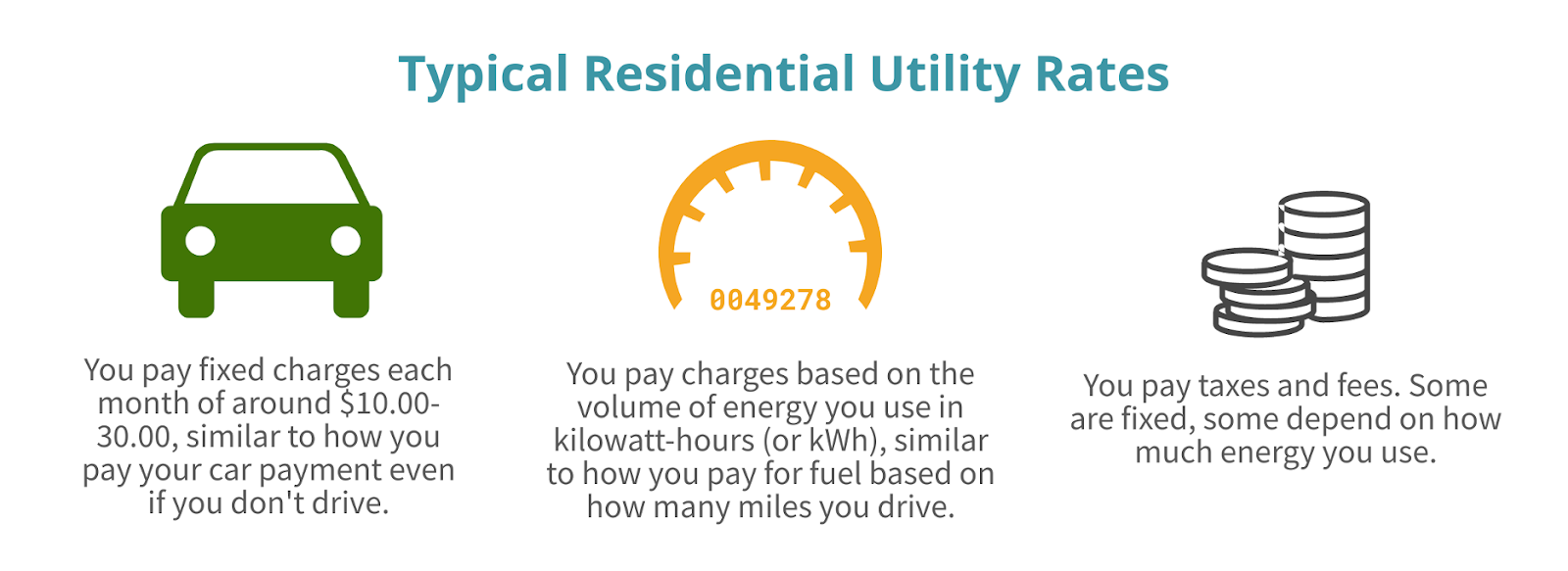
For residential electric customers, your power bills typically have three components: Fixed charges, energy charges, and taxes & fees, as shown in the image below.

Fixed charges are pretty simple to figure out–you just pay that amount each month. TEP calls this charge the Basic Service Charge. For residential customers, TEP is proposing to increase these fixed charges by $2.00 each month. Most homeowners with TEP currently pay either $13.00/month for the residential basic plan or $10.00/month under the time-of-use plan.

Energy charges (often called “volumetric charges”) get a lot more complicated. These charges are based on the energy you buy from your utility. Depending on the specifics of each utility tariff, you might pay more for energy you use in summer compared to winter, or pay more for energy used during particular “peak” times during the day.

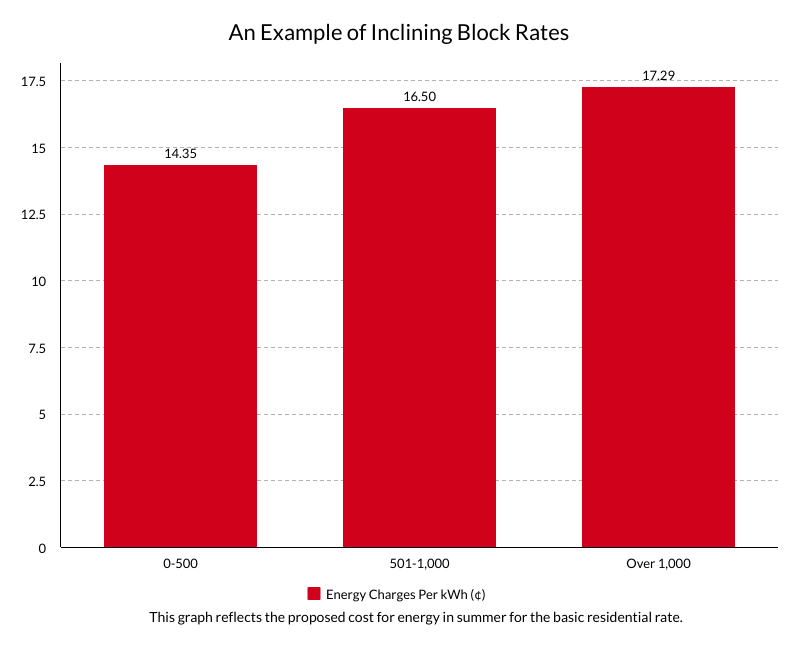
Many utility companies (including TEP) also have what are called “inclining block rates.” 

For example, the image below shows the summer rates proposed for TEP’s residential basic plan:

This means that when you use over a certain amount of energy each month, each additional amount of energy will cost you more per kWh. For example, very small users who only use 500 kWh/month would pay 14.35¢/kWh. But larger users would pay 16.50¢ for each additional kWh 3 they use in the 501-1,000 kWh block, and any kWh over 1,000 used in a month would cost 17.29¢. Although I’m only showing summer rates for clarity, there is also a difference in price depending on time of the year, and energy is more expensive in the summer.

For the residential basic plan that many non-solar homeowners use, TEP is proposing increases to the volumetric rates from around 12.5¢ to 15.5¢ for a typical customer–a significant increase! 

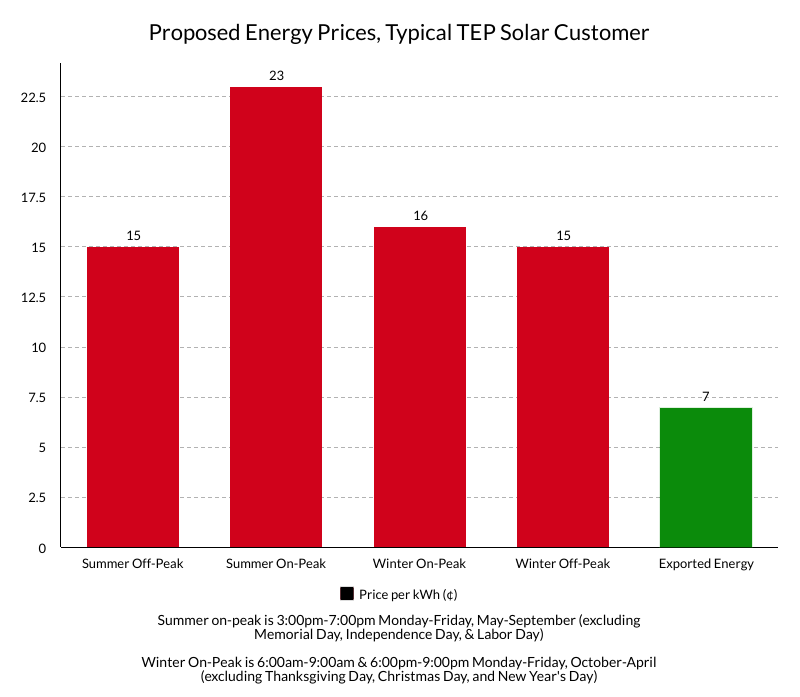
For the residential time-of-use rate that solar customers not on net metering must use, the volumetric rates are more complicated. This rate has an inclining block structure and seasonal differences, but also has peak and off-peak periods. As you can see from the image below, TEP is proposing that electricity would cost a lot more in the summer months during on-peak periods.

These are significant increases from the current rates. Currently, customers on the residential time-of-use rate pay a maximum of around 15¢/kWh for summer peak rates, with off peak and winter rates around 11-12¢/kWh.

Last, we have taxes, fees, and adjustments. They usually scale with the size of your bill, and can be between 5-20% of your total bill. They include things like state sales tax, city sales tax, fees to support the Arizona Corporation Commission, and adjustments for higher or lower fossil gas prices.

TEP is proposing several changes to the fees and adjustments on your bill, which they often call “Riders.” They are proposing eliminating Environmental Compliance Adjuster (ECA), the Renewable Energy Standard Tariff (REST) charge, and the Demand Side Management (DSM) charge. In place, they propose a new “Resource Transition Mechanism.” TEP says this fee would be used to facilitate lower-carbon resources and gradually pass these costs on to customers. TEP is proposing this charge be capped at 3% for now.  

How would TEP’s proposed rates affect existing solar customers who have net metering?

Solar customers who submitted an interconnection request to TEP prior to October 2018 had the option to use net metering. To learn more about how net metering works with TEP electric bills, see our post from 2017.

Because customers can stay on net metering for twenty years from the date of their installation and net metering stays with the house even if you sell it, there are still plenty of customers who have net metering.

Net metered customers would see an increase in their monthly fixed rates from $10.00 to $12.00. They would see the REST surcharge (currently $6-8 a month) go away, but other charges and fees would increase.

However, if you have a net metered solar electric system and your solar electric system produces 100% of the electricity you use in a year, you would experience a fairly small increase in your overall electricity bills.

If you have a net metered system and produce only a portion of your electricity use from solar, you’ll pay increased charges of around 11-15% on the net monthly electricity you purchase from TEP. 

What would the effects be for solar customers with export rates?

Newer solar electric systems have what we call export rates. These systems work in three different “modes” during a typical day – grid use, self-generation, and energy export. To better understand, please see our infographic.

TEP’s proposed rates would affect each of these modes in different ways.

First, let’s tackle grid use, when we’re importing energy from the grid. Solar customers would see the full increase in rates for this portion of the energy they use, with proposed increases in the 11-15% range, depending on how much energy they import from TEP. And on top of this, they’ll pay taxes and fees on any electricity they import. Not great.

Next, let’s look at self-generation (also called self-consumption). In this case, a home is producing energy from the sun, and using it immediately in the home. This reduces the need to purchase expensive electricity from TEP, saving customers more money if the proposed rate increases are approved.

Let’s now look at exported energy. Under TEP’s export rates, solar homeowners are paid a fixed rate for any energy they send out to the grid. This rate is fixed for ten years based on when a solar customer applied to interconnect their solar electric system with TEP’s grid. So even though electricity rates would be higher for energy TEP sells to you, they won’t pay you more for energy you sell to them. 

The image below shows the average prices for imported and exported energy for solar customers with export rates:

Last, like net metered customers, customers on export rates would see increased fixed charges of $2.00/month, but would no longer have to pay the $6-8 monthly REST surcharge.

The end result of the proposed changes is that all solar customers wouldn’t have as large of an increase in their power bills as folks without solar on their homes if the proposed rates are approved. However, all residential TEP’s service territory should expect at least small increases in their bills, even with solar.

How about for homeowners who install solar in 2023 or later?

For new solar customers, the effect of proposed rates would be similar to those experienced by current customers on export rates. Higher rates means higher savings from solar, but also higher cost for any energy imported through grid use. This means that solar becomes a more attractive option, both for current savings, but also as a hedge against any future increases in electricity prices.

For a home with average energy use that consumes 9,641 kWh per year, our preliminary modeling shows simple payback times for new solar installations will likely drop by about six months on average. For larger residential users that consume 18,741 kWh per year, we estimate that simple payback times may drop by as much as 3.5 years.

What happens next?

The rate case is currently moving through the Arizona Corporation Commission. Various stakeholders such as ratepayer advocates, large businesses like Walmart and Kroger, community groups, and solar organizations have “intervened” in the rate case. This means they are able to request data from TEP, fully participate in various hearings with judges and the ACC, file expert testimony, and respond to TEP and other stakeholders throughout the process. You can read all the filings on the rate case docket.

The administrative law judge in the case has also set out a schedule for the rate case. She’s scheduled several public comment sessions (the first tomorrow, February 21st), where TEP customers and other stakeholders can make comments via phone, or for some dates, in person at the ACC’s Tucson offices. 

The judge has also scheduled thirteen days of hearings starting March 29th, at the ACC’s Tucson offices. After final public comments are given on the first day, TEP, ACC staff, and intervenors will give expert testimony, and the same parties will be able to cross examine these expert witnesses.

From there, the case will go to the ACC for a vote, or if TEP, ACC, staff and intervenors agree, they may propose a negotiated settlement to be presented to the ACC for approval.

Questions? Please comment below!

Is Your Arizona Solar Installer Telling You the Whole Story?

It’s a great year to go solar! Prices for installation have never been lower. We have high-quality equipment that is designed to last for more than a quarter century, with 25-year warranties for solar modules, energy conversion equipment, and racking products.

Solar electric systems installed before the end of 2019 are eligible for a full 30% federal tax credit, as well as a $1,000 Arizona tax credit.

But before you sign a contract with a solar installer, make sure that they thoroughly understand how solar can save you money, and that your installer has done their homework before giving you a quote. Read on to learn how solar has changed in Arizona, how you can put it to work for you, and how to avoid being taken for a ride by a shady solar contractor!

A solar electric system installed on the west side of Tucson.

Read More

TEP is Now Providing Customers Easy Access to their Energy Data

Great news! Tucson Electric Power is now complying with Arizona Corporation Commission’s decision from September 2018, requiring that TEP provide “the hourly load data of its customers available in an easily downloadable file from its website” within 60 days, or tell the ACC why they can’t provide this to customers.

TEP has been providing interval data through a clunky request process and providing the info by email (and waiving data request fees), but this has been taking up to ten days, and is certainly not an easily downloadable file! 

Read More

3 Years of Solar: Summary of my 3rd Year with a Solar-Powered Home

In this guest post, Justine Schluntz shares an update on her experience living with solar, after three years of producing clean energy. Thanks Justine!

January 14 marked the 3-year anniversary of my solar PV system getting connected to the grid. Each of the past two anniversaries, I’ve written up a summary of my solar data for the year and shared it here (click for year 1 data and year 2 data). My love for numbers hasn’t gone away and neither has my goal to help others learn more about solar energy, so I’ve decided to continue the tradition and share my system and cost data for a third year.

Schluntz Solar Electric System

Before I continue, it’s important to note that the financial picture for residential solar energy in Arizona has changed since I had my system installed in 2015. This means the numbers I report for costs won’t be consistent with numbers for someone installing a system in Tucson this year. Nevertheless, for many people, solar energy can still be a sound decision from a financial standpoint. If you want to find out what the numbers look like for your home, I encourage you to talk to the very knowledgeable staff at Net Zero Solar, the company I got my system from…

Proposition 127, the Clean Energy for a Healthy Arizona Initiative

We’ve shared a lot of info on Prop 127 on our social media and in a August blog post, but we wanted to directly address some of the recent questions we’ve heard.

We have quite an opportunity on November 6th to transform our energy use here in Arizona! Proposition 127 would require 50% of energy sold by most electric utilities in Arizona to be renewable by 2030!

We strongly support Proposition 127. Ideally, it would not be necessary to put such a measure in the AZ Constitution, but due to the influence of lots of utility money at the Arizona Corporation Commission, it’s our best path to a clean and cost-effective energy future. A 50% renewables will be a good step for a state like Arizona that has a lot of great renewable resources, and the timeframe is reasonable for implementation. It would also create about 16,000 new jobs!

Read More

Let’s Change Arizona through Energy Policy!

A Critical Part of Our Future

When you hear “energy policy,” what comes to mind? Do you think of lawyers and regulators sitting in drab rooms, interminable questions about arcane matters, and stacks and stacks of paper, with all this conducted over months and months? Does “boring” seem a fitting descriptor?

In some sense, this is true. Energy policy, like any public policy, is typically a long, deliberative process, conducted within a legal framework, with many stakeholders who hold diverse opinions. If we focus only on the process, it can seem boring. But that’s wrong. The illusion masks the actual nature of energy policythis work is how we get to a better energy future! We have the choice to fundamentally change how we generate and use electricity, or to remain in the old paradigm that no longer serves either the desires of consumers or greater societal goals.

Read More

What’s the Status of Net Metering for TEP & UNS Electric Customers?

A solar electric system installed in Tucson.

Update Wednesday, September 5th, 2:25pm. The Arizona Corporation Commission has placed consideration of TEP and Unisource Electric rate cases on the agenda for their September 11th-12th Open Meeting. At least until the ACC makes their decision, customers can continue to submit applications for solar electric systems with net metering.

Net metering for TEP and Unisource Electric customers has been a long saga. Although we expected net metering to disappear early in 2018, the case has dragged on due to a variety of factors.

Read More

Net Metering Finally Ending in Tucson

Update, 7:50am, Wednesday, June 13th: I supposed we may have cried wolf again. In an unexpected move, Commissioner Andy Tobin pulled consideration of the item yesterday afternoon, after a vigorous discussion. We are glad that he and the rest of the Commission are carefully considering how their actions would affect consumers and solar installers in Tucson. We’ll let you know when this is again scheduled at the ACC. In meantime, net metering is still available for TEP customers.

Some days, we feel like the solar folks who cry wolf. Over the past several months, we’ve told you that net metering for Tucson Electric Power customers will end on several different dates. Initial expectations were that the case would be completed in January or February. The Arizona Corporation Commission (ACC) even put it on their April open meeting agenda, but later pulled it from consideration.

But unless something happens before next Tuesday, June 12th, at 10:00am, we’re finally at the end of this long process. Items 22 & 23 on the ACC’s agenda are their “Order Relating to Phase-2 Rates” for UNS Electric and Tucson Electric Power.

A ground mount solar electric system installed in Tucson

I won’t rehash our specific thoughts on this case, but we would invite you to read our post from April, Rate Case ReckoningRead More